Description of Upcoming Workshop on Sustainable Variety

Tonight I made some more progress on developing a new workshop, and I wanted to post the description!

David Loughry's avatarProxThink River

Here’s my current description of an upcoming workshop on sustainable variety. I’m thinking of calling it the Get More Sustainable Variety Workshop. I’ll let you know when things are more finalized and you can sign up!

Why Sign Up —
You may share a situation with some friends, family, co-workers or neighbors. Your shared situation is whatever your group is dealing with or considering. With smartphones, we have new possibilities. This hands-on workshop will show you how to combine the Quip mobile app and the sustainable proximities approach, helping you collaborate better to improve shared situations. Doing so can lead to greater sustainable variety, since keeping the proximity alive is boosted by variety. Not only that, this approach gives people chances to relate to the proximity in a wider variety of ways. We’ll use examples most people can adapt to their own lives, and collaborate on some real world…

View original post 24 more words
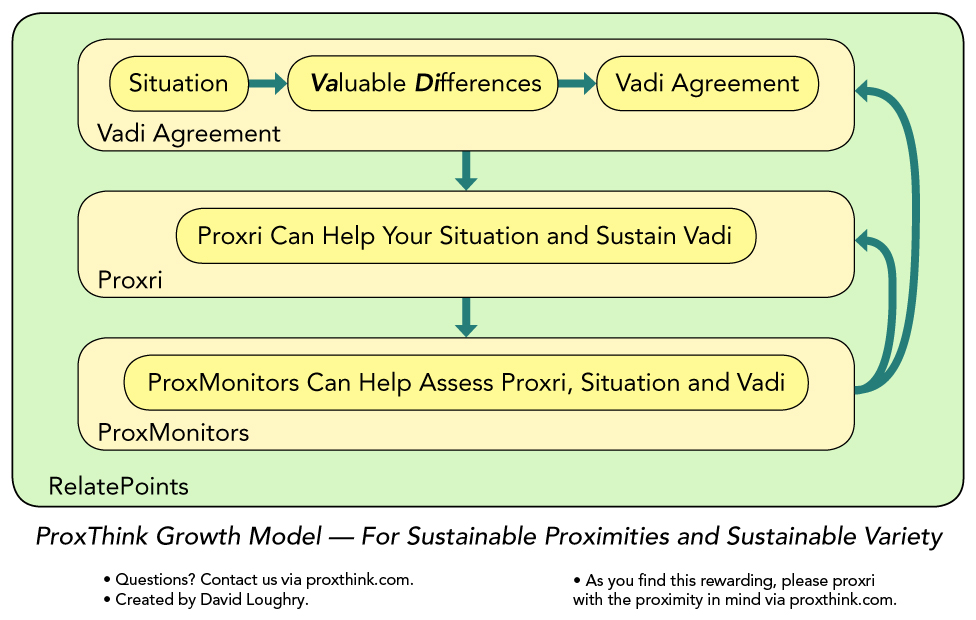
Process Graphic Helps People with Shared Situations Use the ProxThink Growth Model

This will be part of some upcoming workshops I’m developing, but is useful on its own too!

David Loughry's avatarProxThink River

PTGM process graphic 02

Do you and some other people have a shared situation you face together? Your shared situation can be whatever you are dealing with or considering. This graphic shows a process you can use, by starting at the top left and following the arrows (see 7-step overview below). The graphic leverages the ProxThink Growth Model, which makes the proximity more of a tangible thing. As a result, people can better relate to the proximity of their shared situation, which can help them deal with it. This can also help create more sustainable proximities and sustainable variety. You can click the graphic for an enlarged view.

Here’s a very brief 7-step overview of using the graphic.

  1. Adopt one or more RelatePoints for your shared collaboration. I like the Quip app.
  2. Consider and define your shared situation.
  3. Decide what valuable differences you are attempting to create, adapt and/or maintain.
  4. Create at least a simple Vadi Agreement.
  5. Consider needed…

View original post 377 more words

Interesting discussion on Quora about "wanting to do too many things in life" …

Interesting link I shared that relates to my variety life as well, which I discuss a bit in the post.

David Loughry's avatarVariety People

This relates to questions that come up when wanting and/or pursuing a life of variety:
http://www.quora.com/Im-in-my-early-20s-and-is-there-such-thing-as-wanting-to-do-too-many-things-in-life

It reminds me of some of the things I’ve thought about and struggled with over the years. Those struggles were part of how I came up with some of the ideas about being a variety person, and part of why I started this site!

I guess I’m more of the opinion that it’s better to have a certain amount of variety on a daily and weekly basis. Some of the people who responded to the Quora question suggest doing one thing for a number of years and then switching. I’ve done some of that too. But I wish I had been more OK with having more variety during those times. And I wish society was more set up to allow that, rather than generally channeling people to specialize.

View original post

Research Showing Some Variety People May Have More Creative Ideas

A recent post of mine over on varietypeople.org …

David Loughry's avatarVariety People

I was reading an article in Fast Company when I came across some research showing something I had suspected in a general way. It said “individuals connected to disparate clusters of people have more creative ideas than those with homogenous, closed social networks.” It’s based on an aspect of network science called “brokerage,” pioneered by Professor Ronald S. Burt at the University of Chicago.

I have observed over the years that people who explore diverse ideas, areas, people, processes, etc. seem to make more integrated and novel creative connections. Such people are a kind of variety people, and “individuals connected to disparate clusters of people” are a kind of subset of the people I’m talking about. So the research shows, you may well boost your creativity by being the kind of variety person who is connected to disparate clusters of people!

Here’s the link to the full article, about an…

View original post 5 more words

No Fill Marks?

This short video (3.5 minutes) is for people who own French press coffee makers AS WELL AS designers and anyone interested in innovation and creativity. It also uses a mind map you can explore while learning some proximity thinking at the same time!